Showing posts with label Lessons from Hockey. Show all posts

26 May, 2016

An Incorruptible Crown

Know ye not that they which run in a race run all, but one receiveth the prize? So run, that ye may obtain. And every man that striveth for the mastery is temperate in all things. Now they do it to obtain a corruptible crown; but we an incorruptible.
1 Corinthians 9:24-25


Tonight is a huge night in the world of hockey. The Pittsburgh Penguins will host the Tampa Bay Lightning in game seven of the NHL's Eastern Conference Finals to decide who will play the San Jose Sharks for the right to hoist the Stanley Cup. If you're as big of a sports fan as I am, you understand when I say that there's no bigger part of the sports year as far as I'm concerned.

If you try to convince me that there is any more prestigious trophy in sports than the Stanley Cup, you might as well try to argue with a brick wall. I can tell you right now that there will be no sale. There are several reasons for that. First, it's no ordinary trophy, but it's nearly three feet tall and is made up of 35 pounds of silver. Second, it has a history that no other trophy can come close to competing with. If you don't believe me, a quick Google search will reveal some of its bizarre experiences. Third, the winners have their names engraved into the rings on the Cup's base, literally etching them into the history of the sport. Fourth, and perhaps most importantly, it's unique. There's only one Stanley Cup, meaning that no team has a case full of them, including the 24-time Stanley Cup champion Montreal Canadiens.

Well, perhaps a bit of an asterisk should be attached to that last point. While it's technically not incorrect to say that the Cup is unique since the same trophy is awarded year after year, there are, in reality, three Stanley Cups. Obviously, the original 1892 Cup is one. The "Replica Cup," which was made in 1993 is another. Its purpose is common sense. When the "real" Stanley Cup is on official business, the Toronto-based Hockey Hall of Fame displays this version so that fans can still interact with the prized trophy. However, for the purposes of this post, the third version, 1963's "Presentation Cup" is likely the most relevant.

It was in 1963 that NHL President Clarence Campbell commissioned the creation of a new Stanley Cup because he was afraid that the original had become too fragile to stand up to the rigors the trophy was subjected to. If you made that Google search I suggested earlier, you won't have to wonder why. Again, the decision was one based on common sense. If you have as prized of a relic as the Stanley Cup, you naturally want to take care to preserve it. Since its retirement, the Original Cup has been on display in the Vault Room of the Hall of Fame.

In the story of the Stanley Cup, we find that the most timeless of trophies still fall victim to time. Nothing lasts forever. Everything in this world eventually fades away. As the hymn "Abide with Me" says, "change and decay in all around I see." Eventually, this old world itself will burn up, and everything in it will be gone.

I'm not going to tell you that there is no value in some temporal things. I do some work as a high school sports photojournalist, and personally, I think there's a great deal of value in the athletic pursuits those kids I cover take part in because of the character building that can take place. Still, it doesn't last forever. In 100 years, I and the vast majority of them will have long been forgotten for our involvement, proving that point. What then, can we do to establish something that will last forever?

There's only one answer to that question. It is to live a life of service to God. The Apostle Paul used multiple sporting analogies in his epistles to illustrate the importance of perseverance in God's work, but he also pointed out that the glories offered by those sports were temporary. The crown won by ancient Olympians faded away, just as the original Stanley Cup weakened. However, a life lived in service to Jesus Christ will be rewarded with an eternal crown that will survive eternity. It will be something that we can cast at the feet of Jesus in thanksgiving for what He's done for us and be an everlasting reminder.

Ask any hockey fan, and they'll tell you that the Stanley Cup is special. I'm a hockey fan, and I think so. Still, even its grandeur and the glory it bestows upon those that win it are nothing when compared to an eternal reward granted by God Almighty. What kind of trophy are you working for? Is it temporary or permanent?

16 February, 2016

A Great Cloud of Witnesses

Wherefore seeing we also are compassed about with so great a cloud of witnesses, let us lay aside every weight, and the sin which doth so easily beset us, and let us run with patience the race that is set before us.
Hebrews 12:1


It goes without saying that I'm a big hockey fan, but like many other hockey fans, I don't at all like many of the changes that have been made to the NHL in recent years. One such change was made this year, when the All-Star Game was converted into a three-on-three tournament with a team from each division. When that announcement was made, I immediately lost all interest in the event.

Before long, however, something happened that made me start paying attention. Fans were allowed to vote on the league's website for the captain of each team. The highest vote-getter from each division was to win that honor for his team. Every player in the league was eligible, and the fans decided to have some fun with it. A campaign was started to elect John Scott -- then of the Arizona Coyotes -- as the captain of the Pacific Division team.

Before this season, many hockey fans would have responded by asking, "Who?" if someone mentioned Scott. Those who did recognize the name would likely have known of him only because at 6'8", he's one of the tallest players in NHL history. I don't mean to sound brutal, but Scott's on ice stats are far from attention grabbing. In 285 NHL games to date, he has merely five goals and six assists, for a total of 11 points.

Yet, somehow, the campaign took off, and it began to look like a real possibility that Scott would win the vote. Publicly, the league insisted that the fan vote would be honored, no matter the outcome, but it was no secret that the front office was not happy about what was happening. Some fans even charged that back-room deals were at play to keep Scott out of the game. First, he was traded from the Coyotes to the Montreal Canadiens, which the league suggested could affect his eligibility because he was in a new division, and then, he was demoted to the AHL, which was also suggested could make him ineligible.

Those ideas caused an uproar among the fans. In the weeks of the campaign, they had gotten to know John Scott better than some obscure enforcer. They started to get to know him as a funny, happy-go-lucky human being that just about anyone would enjoy hanging out with -- and they were not at all happy about what they thought the league was doing. The response was deafening, and in the end, the league allowed Scott to play.

This is where things start getting stranger than fiction (if they weren't already). Scott not only played, but he scored two goals in the game, and was chosen as MVP. and as a member of the winning team, earned a share of a million dollar bonus -- not a bad deal for a guy whose wife was expecting twins any day!

John Scott certainly appeared to have some pretty powerful enemies to his chance to play in the All-Star Game, and we have some powerful enemies that we battle in our spiritual lives. The world, the devil and his demons, and even our own flesh fight against us every day of our lives. Sometimes we feel like we're all alone, but the truth is, we're not. In John Scott's case, the outrage of the fans was more than enough to offset any plans the league might have had to keep him out of the All-Star Game, and we have forces much more powerful in our corner as we serve the Lord.

First and foremost, we have the Lord. He's far greater than anything the forces of evil can ever conjure up. If he can create a universe in just six days, certainly he's more than sufficient to give us strength in our every day battles. Second, we have the support of the heavenly angels. "For he shall give his angels charge over thee, to keep thee in all thy ways." While I do believe that the concept of guardian angels is greatly overblown in our society, there is some truth that underlies it. The heavenly host does look out for us as we serve the Lord. Thirdly, we have the watchful eye of the saints that have preceded us into Heaven cheering us on. They experienced the same things in their lives that we do, and in many cases, much, much more.

My dear brothers and sisters, as we serve the Lord, we have quite a cheering section behind us. I hope you'll remember that the next time you're tempted to give in or respond wrongly to the pressure of life. We all have those times, and we all know they're coming. If we continue to serve faithfully, we have much more waiting than a temporal MVP award and a monetary bonus. We'll receive eternal rewards that we can lay at our Saviour's feet in thanksgiving for what He has done for us. Remember: they're all cheering for you!

02 February, 2016

The Unbeatable Foe

I can do all things through Christ which strengtheneth me.
Philippians 4:13


It's considered one of the biggest upsets in sports history, and one of the greatest moments in American sports history. It was a huge shot in the arm to a nation mired in a period of malaise. Even with the long, illustrious career Al Michaels has, 36 years later this event is still his signature moment. By now, you've probably figured out that I'm talking about the "Miracle on Ice" when the U.S. hockey team defeated the "Big Red Machine" of the Soviet Union.

That a bunch of college kids could beat the Soviet team of amateurs in name only was unthinkable. The Soviets had won five of the last six Olympic golds, and they dominated the world championships of the era. They had taken some of Canada's top professional players to the brink in the 1972 Summit Series and then beaten them handily in the 1974 rematch. Many of them were teammates on the club level with CSKA Moscow, as well, so they were a true team.

There really wasn't need for any proof that the Soviet team would likely destroy the American team, but we were given some in the run up to the Olympics. The Soviets went 5-3-1 in exhibition games against NHL teams and won the Challenge Cup by defeating the NHL all-stars 6-0. Plus, the American and Soviet teams squared off in a pre-Olympic exhibition match, and unsurprisingly, the USSR won 10-3. Since a stunning loss to the Americans in 1960, the Soviets had been on a tear in the Olympics, going 27-1-1, and they showed no signs of letting up.

There was no reason to believe that February 22, 1980 would be anything other than just another day at the office for the Soviets. There was no surprise when the Soviets struck first, but the the Americans answered. The Soviets scored again, and the Americans tied it again in the last second of the first period. The lone goal of the second period was scored by the Soviets, and going into the third, it appeared that the inevitable would happen, even if not by the margin expected.

Then, something amazing happened. The Americans tied the game on a power play. Then, halfway through the period, Mike Eruzione scored from the slot to give the Americans their first lead of the game, a 4-3 lead that they would hold on to.

The call is now familiar: "Do you believe in miracles?! YES!" As far as hockey was concerned, it was a miracle. The sports world couldn't possibly give more of a David over Goliath than that game did. It seemed impossible, but it wasn't; it happened.

In the Christian life, we will face tasks that seem impossible, and if we try to tackle them in our own strength, they are. If we tried to battle all of our trials ourselves, we'll find that we face steeper odds than the 1980 U.S. Olympic team. The truth is, however, that they are not impossible. We have a source of strength that will allow us to win every battle if we will tap into it.

In Matthew chapter four, Jesus was tempted by Satan, and He easily overcame it by quoting scripture. We as Christians have that same resource. We have the Holy Spirit in our hearts, meaning that God Himself is with us at all times, and is there to help us. He has promised us a way to escape temptation. "There hath no temptation taken you but such as is common to man: but God is faithful, who will not suffer you to be tempted above that ye are able; but will with the temptation also make a way to escape, that ye may be able to bear it."

In a one-on-one battle with Satan, you're a huge underdog, and so am I. In fact, we're guaranteed losers. But, thanks be to God, through His strength, we have the chance to win every battle. That's more cause for celebration than the "Miracle on Ice." It's part of the miracle of salvation.

07 January, 2016

The "Repentance" of Stan Mikita

But sanctify the Lord God in your hearts: and be ready always to give an answer to every man that asketh you a reason of the hope that is in you with meekness and fear: Having a good conscience; that, whereas they speak evil of you, as of evildoers, they may be ashamed that falsely accuse your good conversation in Christ. For it is better, if the will of God be so, that ye suffer for well doing, than for evil doing.
I Peter 3:15-17


After every NHL season, the Lady Byng Memorial Trophy is presented to the "player adjudged to have exhibited the best type of sportsmanship and gentlemanly conduct combined with a high standard of playing ability." An enforcer or a player known for rough play cannot win the trophy, no matter how skilled they are or how well they perform on the ice. Stan Mikita won the award in 1967 and 1968, but just two years before his first win, no one would have ever dreamed that he would ever receive it. You see, there was a key event in Stan Mikita's life that caused him to change his style from that of a bruiser to the sport's ultimate gentleman.

Five times in the early years of his career, Mikita was in the top 10 of all players in the NHL in penalty minutes, amassing anywhere from 97 to 154 PIM in those seasons. He was known as a dirty player -- a reputation that he very much deserved -- and everyone knew not to mess with him on the ice. While no one likes a dirty player that doesn't play for the team he cheers for, that physical style of play has always been considered to be a part of hockey. Everyone understood that, and no one asked questions... Well, almost no one, that is.

Upon returning from a road trip, Mikita's wife told him a story that made him re-evaluate his style of play. She and their daughter had watched one of the Black Hawks' road games, and the young girl had asked her mother a question: "Why does Daddy spend so much time sitting down?" Mikita's wife related that story to her husband when he arrived home.

For a moment, try to put yourself in Mikita's place. What would you say? Would you really want to say, "Well, Sweetheart, Daddy breaks the rules a lot and does mean things to people?" Of course not! Neither did Mikita. He credits that incident for changing him as a player. The effect was immediately noticeable. In 1964-65, he had 154 penalty minutes. That number fell to 58 in 1965-66 and 12 in 1966-67. He never again had more than 85 PIM in a season or finished in the top 10 in that stat. In fact, he's generally now thought of as a gentlemanly player.

Mikita's daughter was watching him, and there are people who watch you. Maybe they're your children, your grandchildren, or your nieces and nephews. Maybe they're not related to you. Maybe they're not children. It doesn't really matter who they are; the way you live your life in front of them is what you're telling them life should be like. If someone were to come to you and ask you why you do the things you do, could you answer in confidence, or would it be a sting to your conscience in the way that Mikita's daughter's question was?

If life had a penalty box, how much time would you spend sitting down? Would someone be likely to ask why you spend so much time sitting down? We're all human. As long as we're in this life, there's no such thing as sinless perfection, but the times that we fall should be the exception rather than the rule. It would have been a lot easier for Mikita to answer his daughter in one of the seasons that he had 12 penalty minutes than the one in which he had 154. By the same token, if our lives are lived in accordance to the principles of God's word, it will be much easier for us to give the answer about the hope that is within us. That's what makes us ready to give the answer.

Stan Mikita's penalty minutes are now a matter of record, and nothing can change that. Your past is in the past, and nothing can change it. You can, however, change the future. Is there something in your life that would discourage someone from wanting Jesus Christ in his heart because your life tells him it's not worth it? If so, do what Stan Mikita did. Repent of those things and with the help of God, turn over a new leaf.

01 January, 2016

The Consistency of Mike Gartner

Moreover it is required in stewards, that a man be found faithful.
1 Corinthians 4:2


Wayne Gretzky won five goal-scoring titles, eleven Art Ross trophies, and won the Hart nine times. He had an NHL record 92-goal season, another eighty goal season, and two more 70-goal seasons, and is tied with Mike Bossy for the most 60-goal seasons (5) and 50-goal seasons (9). Gordie Howe led the NHL in goals five times, won six Art Ross, and won six Hart Trophies. Brett Hull had three consecutive 70-goal seasons (scoring 86 in one of them) and won the Hart Trophy in 1991. Jaromir Jagr has five Art Ross trophies, a 62 goal season in 1995-96, won the Hart in 1999 and the Pearson on two other occasions. Marcel Dionne won the Art Ross in 1980 and won the Pearson twice. Phil Esposito posted the first 70-goal and first four 60-goal seasons in NHL history. He led the league in goals six times and won the Art Ross five. He won two Hart Trophies and won the Pearson on another occasion.

You're probably wondering what I told you all of that. Well, I told you all of that to tell you this: despite the fact that Mike Gartner never did any of that, he is the only other member of an exclusive club that includes all of the names above. They are the only seven players in NHL history to score at least 700 goals in their careers. His highest single season goal tally was 50, and he hit that only once. He never finished higher than fifth in the league in goals or tenth in points. He never finished any higher than fourth among right wingers in all-star balloting. How then, did he manage to score so many goals?

Remarkable consistency was the secret to Gartner's success. From the 1979-80 season through the 1993-94 season, he never failed to score at least 30 goals. After the lockout-shortened season that followed snapped his streak, he managed two more such seasons, bringing his total to 17. The consecutive and total 30 goal seasons marks are both NHL records. Mike Gartner was never among the game's elite players and he was never considered to be a super star, but his nearly unmatched level of consistency meant that he was dependable. Year in and year out, you knew what you were going to get from Mike Gartner. That earned him his spot among that elite company and in the Hockey Hall of Fame.

When people look at our lives and our Christian service, they should have the same feelings about us. "But let your communication be, Yea, yea; Nay, nay: for whatsoever is more than these cometh of evil." The way we live should be a matter of what you see is what you get. You don't have to be the best at whatever you do, but God does expect you to faithfully serve Him to the best of your ability.

Last night, my church had a watchnight service to welcome in the new year. The final preacher of the night is a member of the church, and when our pastor introduced him to the pulpit he said that he was going to give him the best compliment that he could think of to give to any Christian: he's faithful. Our measure of success in the Christian life is just that. The only thing God expects us to do is be available to Him. As it has been said, the best ability is availability. As the hymn "Our Best" reminds us, "our talents may be few, these may be small, but unto Him is due our best, our all.

It doesn't matter if you're a great singer, or a great teacher, or a great musician, or a great anything by the standards of your fellow man. It is true that your service should prove to them that you are dependable and faithful, but none of us should strive to impress any other person. We should strive to impress God. Mike Gartner's career is a good model as to how to do that. Don't try to match anyone else's best. Simply go out day by day and give your all to the Lord. It might not be noticed on earth, but it is noticed in Heaven. God will always reward faithfulness.

15 December, 2015

One Man Doesn't Make a Team


From whom the whole body fitly joined together and compacted by that which every joint supplieth, according to the effectual working in the measure of every part, maketh increase of the body unto the edifying of itself in love.
Ephesians 4:16

As the 1988-89 NHL season began, the city of Los Angeles was truly buzzing about hockey for the first time. The league had put down stakes in the city over two decades earlier, but had been little more than a side note on the city's sports pages during all of those years. Now, celebrities who had long made appearances at Los Angeles Lakers games were being spotted rinkside. What made the difference? One man: Wayne Gretzky.

Most fans consider "The Great One" to be the greatest player in the history of the sport. He holds too many NHL records to count, the most visible being his 894 goals, 1,963 assists, and 2,857 points. In fact, Gretzky's assist total alone is big enough to make him the NHL's all-time leading scorer. He had four 200+ point seasons in his career. No one else even has one. He won nine Hart Trophies as league MVP. Even "Mr. Hockey," Gordie Howe can only boast six. Probably most importantly at the time, however, is the fact that Gretzky was the face of the Edmonton Oilers dynasty.

Gretzky and the Oilers had just won their fourth Stanley Cup in five years the season before. At the beginning of the season, Gretzky was still just 27 years old. That meant that Kings fans could expect a dynasty of their own, right?

Before I answer that, let's take a step back and look more broadly at those Oilers rosters. In addition to Gretzky, Mark Messier, Jari Kurri, Paul Coffey, Glenn Anderson, and Grant Fuhr all suited up for Edmonton -- an impressive list of Hall-of-Famers to be sure. Gertzky might have been the most famous -- even most talented -- member of the roster, but sole credit for the dynasty did not belong to him. In fact, two years after the trade that sent Gretzky from Alberta to California, the Oilers won yet another Cup.

It was not until Gretzky's fifth season in Los Angles that the Kings made it to the Stanley Cup Finals. By this time, Kurri and Coffey had joined him, but neither posted numbers that were at all reminiscent of the production north of the border. The team also had Luc Robitaille and Rob Blake, but there could be no question that top to bottom, the roster wasn't nearly as good as those Oilers teams. In the 1993 Finals, the Kings were summarily dispatched 4-1 by the Montreal Canadiens. As it turned out, his fourth Cup in Edmonton would be the last of Gretzky's career.

Why didn't Los Angeles end up with a dynasty like Edmonton had? I think the answer is simple: one man doesn't make a team. I mean no offense to any of the talented men who played alongside Gretzky in Los Angeles. The fact that they were in the NHL speaks volumes about their talent. Still, when Gretzky arrived, many thought that meant the team was headed to the promised land. Gretzky was going to do it all.

Far too often, I think that mentality prevents churches from being champions for the Saviour. "The new pastor is such a great preacher. Our church will grow as long as he's here." "The music director is doing a great job with the choir. As long as we have that kind of music service, our church is in fine shape." "We have the best Sunday school teachers around. That should draw in a lot of new people." All of those things may be true, but if 90% of the members of the church are content to simply take their place on the pew and let "Wayne Gretzky" do all of the work, the church will never be all that it can be.

Here's my question: what are you doing? Are you playing your part? Maybe the world doesn't look at you as a superstar, but if God has placed you in a church, he has a job for you to do in that church. Are you doing it? No church will ever be all that it can if its members don't do their parts. Maybe you can't preach or teach, sing or play, but there are things you can do. Do you pray for your church? Do you invite others and tell them about Jesus? If not, you're not playing your part and allowing someone else to carry the load, thus reducing their effectiveness.

You don't have to be Wayne Gretzky. You simply need to play your role to the best of your ability. Don't expect the pastor, the deacons, or the Sunday school teachers to do it all. Embrace God's calling on your own life, and you just might see your church turn into a champion.

18 November, 2015

The Perseverance of Ray Bourque

And let us not be weary in well doing: for in due season we shall reap, if we faint not.
Galatians 6:9


The 2000-01 NHL season was Ray Bourque's last. His 410 goals, 1,169 assists, and 1,579 points were all (and still are) records for defensemen. He won five Norris Trophies as the league's best defenseman, was a 13-time first team all-star, and was even runner-up in Hart Trophy balloting in 1990 - a feat nearly unheard of for a defenseman. His career exploits were so great that three years before he retired, he was ranked 14th on The Hockey News' list of the 100 greatest players of all-time.

As impressive as that resume is, there was one thing missing. After playing in 1,612 regular season games, and 22 seasons, Ray Bourque still had not earned the one honor that players most crave -- the right to hoist the Stanley Cup and have his name engraved on the prestigious trophy. Those were the most games and seasons played by a player never to have won the Stanley Cup.

Bourque spent his first 20 seasons, and most of his 21st with the Boston Bruins. In 1988 and 1990, the Bruins advanced as far as the Stanley Cup Finals, only to run into the buzz saw that was the Edmonton Oilers dynasty. As much as Bourque loved playing in Boston, a disappointing season in 1999-2000 proved to him that we would not have a chance to win the Cup with the Bruins, leading to his requesting a trade. Bourque requested a trade to an East coast team, but unbeknownst to him, General Manager Harry Sinden, who also desired to see Bourque win the Cup, was closing a deal with the Colorado Avalanche. When the trade was finished, Sinden told Bourque, "This may not be your first choice, but this is the team I believe is best."

Bourque played only a handful of games with the Avalanche that season, but the team came as close as one goal from the Stanley Cup Finals, giving a lot of hope for the next season. For the 2000-01 season, Bourque was named an alternate captain, and was a key piece of the team. At 41 years old, he earned recognition as a first team all-star and was runner-up for the Norris. After winning the President's Trophy with the league's best record, the team then successfully navigated the Western Conference playoffs to reach the Stanley Cup Finals, where they faced the defending champion New Jersey Devils.

It seemed that Bourque's dream would fall short once more when the Devils took a 3-2 series lead, putting them one win away from repeating, but the Avs rallied to win games six and seven to win. It is a tradition that the league commissioner hands the Stanley Cup to the winning team captain who hoists it first, but on that night, Colorado captain Joe Sakic broke that. After receiving the Cup from Gary Bettman, Sakic immediately passed it off to Bouruqe, allowing him to raise it first, and sent him around the ice with it. Of all the players that I've seen lift that Cup, Bourque's moment is still my favorite. Following that season, Bourque retired, finally having the final piece of the puzzle.


Had Ray Bourque given up on his goal before the final game of his career, there would always be something missing. By the same token, if we give up on the Christian life before the "final game," if you will, there will be something missing from our resume. "I press toward the mark for the prize of the high calling of God in Christ Jesus," but if I quit before I reach the finish line, I will not have reached the final goal. I'll get into Heaven by the blood of Jesus Christ, but I will not have been all that I could have been for the Lord.

We can't quit until our "careers" are completely finished. The day we stop is the day the Lord calls us home. We do not receive an earthly trophy for this, but we get something much better. We will one day receive heavenly rewards that we can cast at the feet of our Saviour in thanksgiving for what He has done for us.

We're all tempted to give up at times. There are times that our flesh feels that we're wasting out time and that nothing will come of our service. The next time that happens to you, remember Ray Bourque. Then remember that you're competing for something much greater than the Stanley Cup, We're competing for an "incorruptible crown." The joy he experienced that day will not compare to the joy we will experience in the presence of our Saviour. Follow Ray Bourque's lead. Don't quit until it's over.

10 September, 2015

Are You Willing to be Second?

And thou shalt love the Lord thy God with all thine heart, and with all thy soul, and with all thy might. Deuteronomy 6:5


Brad Park is widely considered to be one of the best defensemen in NHL history. He is considered by many (myself included) to be the best player in the history of the New York Rangers. With a reputation such as that, many would probably find it surprising that he never won a Norris Trophy as the NHL's top defenseman.

Park's reputation is deserved. He was a five-time first team all-star, and a six-time runner-up in Norris Trophy balloting. Why then, was he never acknowledged as the best at his position? One name answers that question: Bobby Orr.

Park was a "victim" of the era in which he played. Four of the six second place finishes were to Orr while the latter was on a streak of eight consecutive Norris wins. In fact, Orr won three Hart Trophies as league MVP during that span, and had a strong argument for more. To put Orr's accomplishments into perspective, consider these facts: It's almost unheard of for a defenseman to win the Hart, and Orr racked up his accomplishments during a career which spanned only nine full seasons. Orr is also credited with changing the way the game is played since he popularized the concept of a "rushing defensman."

With all that in mind, it's very easy to see why the awards were piled on Orr while Park was left out in the cold, so to speak. At any other time in NHL history, after the introduction of the trophy, Park almost certainly would have won Norris awards. We're all human, and we know how human nature works. We like to win. We like to be acknowledged as being great as something. So, how do you think Park felt about his status as perpetual runner-up?

The answer is easy to find. Park once gave it himself. "I saw no reason to be upset because I was rated second to Bobby Orr. After all, Orr not only was the top defenseman in the game, but he was considered the best player ever to put on a pair of skates. There was nothing insulting about being rated number two to such a super superstar."

That was reality, and Brad Park was man enough to face it. In fact, he even watched Orr's play with the hope of improving his own. "Bobby had a definite influence on my play. I began studying him during the 1968-69 season. While I was recuperating from my broken ankle, I got a chance to watch Bobby a bit closer in a couple of games on television and a couple more in person. I'll tell you this, he slowed things down and when he suckered somebody in, he'd burst around them with his fantastic accelerations." Brad Park accepted that Bobby Orr was first and that he was second, and he made the most of it.

Now, with all of that in your mind, let me ask you some questions. Who is in first place in your life? Is it you? Do you live your life looking out for "number one," trying to put yourself ahead of all others? If you do, you're in for a sad awakening one day. None of us will ever be "number one." This life isn't about us. Rather, it's about Jesus Christ.

I hope you'll forgive the crude illustration, but Jesus Christ is the Bobby Orr to our Brad Park. No matter what we accomplish, and no matter what successes we have in this life, we'll never measure up to Him. To fight that is only to bring misery into our own lives.

Similarly, just as Brad Park determined to better his game by watching Orr's, we can better ourselves by observing Jesus. We have the perfect model for how to live our lives in the Gospel narratives about Him. As great as Orr was, however, and as much as there was for someone who observed him to learn from him, he wasn't perfect. That's not so with Jesus. He is perfect. His example will never fail us.

Ultimately, though, we have to go a step further if we want to make the most out of our lives. It's not enough to simply acknowledge that He's greater than we are and follow the pattern He left for us. We must realize that our purpose in life is His pleasure. That's why we were created. To find the ultimate fulfillment, we must accept Him as Lord and live our lives in His service. Even then, God will be a debtor to no man. Those who have served Him faithfully will receive eternal rewards at the judgment seat of Christ and will hear the greatest words they could ever receive: "Well done, thou good and faithful servant."

What place do you hold in your life? If it's first place, you've got it all wrong. This is one instance that striving for first won't win. It's a guaranteed loser. Do you want to win? If so, put Jesus Christ first. Are you willing to be second?

28 August, 2015

How Will You Be Remembered?

And the rest of the acts of Solomon, and all that he did, and his wisdom, are they not written in the book of the acts of Solomon? 1 Kings 11:41


The hockey world is in mourning today, following the news of the death of legendary New York Islanders head coach Al Arbour. He passed away today at the age of 82. As of the time of this writing, I have been unable to learn his exact case of death, but he was known to be suffering from dementia and Parkinson's disease.

Arbour played all or part of 14 seasons in the NHL, winning three Stanley Cups, but is most known for his coaching career, during which he compiled a 782-577-248 record with the St. Louis Blues and New York Islanders. His tenure with the Isles was legendary, and he coached the team to dynasty status winning four consecutive Cups from 1980-83. The respect he earned from those years was so great that during the 2007-08 season, when then-Islanders head coach Ted Nolan realized Arbour had coached 1,499 games with the team, he invited him to come back for one more game to make an even 1,500. Arbour's 782 wins and 1,607 games coached are second all-time in NHL history, behind only Scotty Bowman's marks.

I woudn't be one bit surprised to see a book on Arbour's life and career released soon. It almost seems inevitable considering the amount of success and respect he earned. Looking at it from the vantage point of a hockey fan, I'd say it would be a very fitting and appropriate thing.

That said, there has already been a book written on the life of Al Arbour. It was written over the course of 82 years, and it was written by none other than Al Arbour. At every point during his life, there was someone who watched him and observed the things he did. As such, he wrote a book for those people. When he played and especially when he coached, there were a large number of people who watched him. He wrote a book for those people.

I don't know if you've ever thought about it, but you're also writing a book. Now, your book may not be a best-seller, and very few of us will ever have as many readers as Al Arbour did, but we're all writing one nonetheless.

Those who are close to me know very well how passionate I am about writing. I write this blog, I write a blog on hockey history, I have written the drafts of a few novels I hope to see published one day, and I have pieces of other stories and a few hockey player biographies written. However, I feel very safe in saying that no matter how successful any of those writings may one day be, they are not as important as the book that I'm writing for those who are watching me.

Many people have written books for me. I'm very grateful for many of them, while others have deeply disappointed me. Whether I like what I've read or not, though, they have all helped shape me into the man I am today. In the same respect, I'm helping to shape those who are coming up watching me with the book I'm writing.

As our text verse says, Solomon wrote a book with the way he lived his life. It was finished thousands of years ago. Al Arbour wrote a book that finished today. You and I are both writing books that will end one day as well. Are we writing Godly books that will point others to Jesus Christ, or are we pushing people away from Him? One day, it will all be revealed. Will we have reason to be ashamed, or will we hear "Well done, thou good and faithful servant?"

20 August, 2015

What Are You Living For?

Lay not up for yourselves treasures upon earth, where moth and rust doth corrupt, and where thieves break through and steal: But lay up for yourselves treasures in heaven, where neither moth nor rust doth corrupt, and where thieves do not break through nor steal: For where your treasure is, there will your heart be also. Matthew 6:19-21


Howie Morenz loved to play hockey. It doesn't feel unfair to say that he lived to play hockey. He was one of the NHL's first superstars, and with three Hart Trophy wins (1928, 1931, and 1932), he was arguably the best player in the world from the late 20s through the early 30s. He led the NHL in goals, assists, and points in the 1927-28 season, and in points again in the 1930-31 season. Yes, Howie Morenz loved to play hockey, and he played it very well.

Morenz spent his glory years with the Montreal Canadiens, and loved playing in Montreal so much that he once said, speaking of the Canadiens, "When I can't play for them, I'll never put on a skate again." In reality, everyone knew that wasn't true, because Howie Morenz's love for hockey would overwhelm that sentiment if he were ever to be traded.

Such a trade came in 1934, when he, goaltender Lorne Chabot and defenseman Marty Burke were traded to the Chicago Black Hawks for Leroy Goldsworthy, Lionel Conacher, and Roger Jenkins. Unsurprisingly, Morenz did put on skates for Chicago and spent a season and a half there before being traded again, this time to the New York Rangers for Glen Brydson.

Morenz's stay in New York would be brief. In 1936, the Canadiens brought back their former head coach, Cecil Hart. One of Hart's conditions for returning to coach the team was that Morenz be brought back, which the team did. Morenz's return to his beloved Canadiens seemed to jump start his play, as his stats were noticeably improved from the previous season, but he wouldn't make it through the end of the campaign.

On January 28, 1937, in a game against the Black Hawks, Morenz was checked by Earl Seibert, while rushing into the offensive zone. His left skate was caught in the ice as he went down, leading to a severe leg injury in which his leg was broken in four places. He spent weeks in the hopsital, and convinced the injury had ended his career, he slipped into a depression and suffered a nervous breakdown.

On March 8, Morenz complained of chest pains, and his wife Mary and Hart were summoned to the hospital. Before they arrived, he got out of bed to go to the washroom, and collapsed and died, minutes before their arrival.

The official cause of his death was a coronary embolism, but fellow Canadien Aurel Joliat offered another very likely suggestion. "Howie loved to play hockey more than anyone ever loved anything, and when he realized he would never play again, he couldn't live with it. I think Howie died of a broken heart."

What do you live for? If every worldly possession and talent you had were taken away from you, would you have any reason to continue in life? If you live for the world, the answer is no. The fact of the matter is, that one day, whether through loss or death, all of it will one day be gone. This world is temporary, and the things it offers can't last.

There is nothing wrong with having hobbies and interests, but life is meaningless if it's lived only for this world and what it can offer. Most people live such a sad, meaningless life. They fail to keep the things of this world in their proper place. Those who don't know Jesus Christ are doomed to a life like that as long as they don't know Him. Christians aren't destined to such an existence, but sadly, many choose to live life like that.

If our lives are to have any meaning whatsoever, we must live for the Saviour and for Heaven. Deeds done with God as the focus will last for all eternity. They can't burn up, they can't decay, and they can't be stolen. If our treasures are in Heaven, we have something to live for even if everything in the world were taken away from us. 

15 August, 2015

The Death of Bill Masterton

Boast not thyself of to morrow; for thou knowest not what a day may bring forth. Proverbs 27:1


Before 1967, the NHL was a highly exclusive club. With only six teams in the league roster slots were few, and that left many skilled players without a job at the highest level of their sport. That began to change when the league doubled from six to 12 teams for the 1967-68 season. When the number of teams doubled, so did the number of players, giving a lot of guys that had previously had little to no opportunity in the NHL to permanently make the jump.

One player who got his big break with the expansion was Bill Masterton. The native of Winnipeg, Manitoba played college hockey at the University of Denver, and signed with the Montreal Canadiens in 1961 after receiving his degree, but with future hall-of-famers Jean Beliveau and Henri Richard and all-stars Ralph Backstrom and Don Marshall all playing his center position, there was little chance that Masterton would make the Canadiens team.

Masterton played a season with the Hull-Ottawa Canadiens of the Eastern Professional Hockey League and a season with the Cleveland Barons of the American Hockey League before leaving professional hockey to settle in Minneapolis, Minnesota. He acquired American citizenship, allowing him to play for the United States national team, which he captained in 1966-67.

When the NHL expanded into his adopted home in the Twin Cities in the form of the Minnesota North Stars, Masterton jumped at the opportunity to play for the new franchise. He was the first player to sign with the North Stars, and scored the first goal in the team's history in an opening night 2-2 tie with the St. Louis Blues.

While not a superstar, Masterton was a solid member of the North Stars. In 38 games with the team, he scored four goals and 12 points. However, his career -- and his life -- abruptly ended after a game against the Oakland Seals on January 13, 1968.

In the first period of the match, Masterton was checked simultaneously by two Seals defenders. He fell backwards onto the ice, and because hit his head on the ice. Like most players of the time, Masterton wasn't wearing a helmet, and the force of the impact caused him to lose consciousness and bleed from his ears, mouth, and nose. Some said that he momentarily regained consciousness and muttered "Never again, never again," before passing out again.

Those words proved to be prophetic. Doctors who examined him at the hospital quickly determined that surgery wasn't an option, and on January 15, a mere 30 hours after his injury, Bill Masterton died, with his wife, children, parents, and brother at his side.

Bill Masterton lived the dream of every hockey player when he ascended to the NHL level. In doing so, he had reached the pinnacle of his sport. But, he had no way of knowing when he awoke on the morning of January 13, that it would be the last time he would do so. None of us can guarantee that this morning wasn't the last time we will do so either.

We don't know when death will come, but we can count on the fact that it is coming. There are many appointments that we can postpone or break, but our appointment with death is not one of them. Death is no respecter of persons. It takes the old; it takes the young. It takes the rich; it takes the poor. It takes those on top of life; it takes those in the gutter. Eventually, it takes all.

My friend, death is coming for you and me, just as sure as it came for Bill Masterton. If it were to come for you today, would you be ready? Would Heaven be your home? Would you meet your Saviour ashamed because you didn't serve him faithfully? We need to be ready. We only have one chance.

08 August, 2015

The Forgiveness of Ace Bailey


And be ye kind one to another, tenderhearted, forgiving one another, even as God for Christ's sake hath forgiven you. Ephesians 4:32

On December 12, 1933, the Toronto Maple Leafs visited the Boston Garden for an NHL game against the home-standing Boston Bruins. What no doubt seemed like a typical night to the players involved and fans in attendance would prove to be anything but. It would be a life-changing night for some involved, and the beginning of a chain of events that reveal one of the greatest human examples of forgiveness I have ever heard of.

In my opinion, Bruins defenseman Eddie Shore was the best player of the 1930s, and his four Hart trophies from that decade support that. As great a player as he was, he had a temper as big as his talent, and today he is as well known for that temper as anything else. It was that temper that would lead to the near tragedy that took place on that December night.

Shore's anger was triggered after he was checked by Toronto's top defenseman, King Clancy, as the former charged up the ice. The hit dazed Shore and threw him into a rage. Immediately, he decided to get his revenge. Setting his sights on a man he believed to be Clancy, Shore charged at the player and hit him from behind. His target fell to the ice and struck his head. Little did he know, he had not hit King Clancy, but rather star right winger Ace Bailey.

Upon witnessing the incident, Maple Leafs defenseman Red Horner, who had a temper to match Shore's, raced over to Shore demanding to know what he was thinking. Saying nothing, and feeling satisfied with his actions, still thinking he had hit Clancy, Shore said nothing and simply smiled. Needless to say, the response infuriated Horner who knocked Shore out cold with a single punch.

Shore's injury required a few stitches, but was nowhere near as severe as Bailey's, whose skull was fractured by the force of the impact when he hit the ice. When he woke up, Shore was informed about what had happened, and hearing that he had hurt Bailey, and that his victim might die, he asked for permission to go to the Maple Leafs' locker room to apologize.

When Shore arrived in the locker room, he found that Bailey had regained consciousness. Upon receiving Shore's apology, Bailey, who was lying in the locker room, expecting to die responded with an amazing level of grace and forgiveness by saying, "It's all part of the game," before losing consciousness again.

Bailey was rushed to a hospital where doctors began surgery to try to save his life. Even with the surgery, his injuries were so severe that doctors gave him only hours to live. Since Shore's deliberate actions had sent Shore to the edge of death, Boston homicide detectives announced that they intended to charge Shore with manslaughter in the event of Bailey's death. Bailey survived beyond the hours that his doctors expected him to live, but even after that, his life hung in the balance. Shore, meanwhile was suspended indefinitely by league president Frank Calder, and would eventually miss 16 games as a result.

In fact, Bailey would teeter between life and death for a month. During that time, Shore was forbidden to visit Bailey in the hospital, though Bruins manager Art Ross was able to do so. When Ross visited, Bailey reiterated that he did not hold Shore responsible for the incident and did not believe that Shore had intentionally injured him.

Against all odds, Bailey survived, but it was clear that his hockey career was over. Since a hockey career wasn't a high paying career in the 1930s by any stretch of the imagination, Bailey was far from being set for life. As a result, Calder decided to put on an all-star game which would serve as a benefit for Bailey and his family. Bailey's Maple Leafs teammates would face off against a collection of all-stars -- two from each of the other teams -- on Valentine's Day, 1934 in Toronto's Maple Leaf Gardens. Unsurprisingly, one of the selections from the Bruins was none other than Eddie Shore. Lester Patrick, head coach of the New York Rangers was chosen to coach the all-star team.

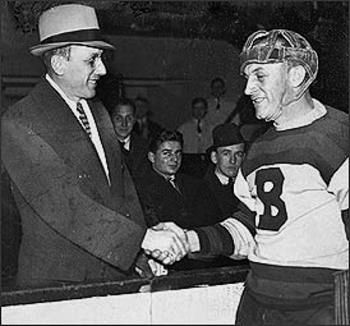
Before the game, there was a ceremony in which the all-stars received their jerseys for the game from Calder, Patrick, and Bailey. The players came forward in numerical order. Number one was Chicago Black Hawks goaltender Charlie Gardiner. Number two was Eddie Shore. Over 14,000 fans in attendance became dead silent when they saw Shore skating toward Bailey. Shore was also nervous about the meeting. When Shore arrived, Bailey extended his arm and shook hands with Shore, and the pair received a roar of approval from the crowd. So far from being booed as he expected, Shore found that he was cheered when he would rush the puck following Bailey's gesture.

Not one of us is capable of the level of forgiveness that we receive from God, but Ace Bailey came about as close as anyone could in his exchanges with Eddie Shore. I believe his willingness to forgive can bring the forgiveness of God to life as well as demonstrate the kind of forgiveness that we should show to others.

I don't believe that most people live their lives intending to offend God, and yet that's just what each and every one of us do with our sin. The consequences for our sin are so great that they sent Jesus Christ to a cross. Yet, while He was dying for crimes He did not commit, he prayed, "Father, forgive them; for they know not what they do." Beyond that, if we will but turn to Him and accept His grace, He will receive us with opened arms and restore the fellowship that we lost in the fall.

With that in mind, how can we withhold forgiveness from others? The text verse teaches us that we are to forgive others because Jesus Christ has forgiven us. Our salvation can come from nothing other than the blood that He shed in our stead, for our crimes, on a cross that should have been ours. Because of that, we owe Him all. The least we can do is be willing to give our forgiveness to others after He did the same for us.

True forgiveness does not hold offenses from the past over the head of the guilty party. Just as God's forgiveness doesn't remember our sins, we should also be willing to let the wounds of the past remain in the past. We can learn a lot from Ace Bailey. The forgiveness he showed Eddie Shore is a beautiful picture of God's forgiveness for us, and a great example of the forgiveness that we should show to others.